
How to Build the Perfect Personal Credit Profile for Business Funding
Your personal credit score is the first thing most lenders, banks, and funding sources look at before they will consider your business. Here is exactly what they want to see — and how to build it.
Your Personal Credit Profile Is a Business Funding Foundation
Many entrepreneurs focus so heavily on business plans and ideas that they overlook the one thing most lenders will check first: your personal credit history. Before a bank, SBA lender, or alternative funder releases a single dollar, they want to know how you have handled your own financial obligations.
This guide walks you through the five FICO factors that shape your score, what score benchmarks lenders actually require by funding type, a step-by-step strategy for building a stronger profile, and the most common mistakes that quietly kill funding applications.
Why Personal Credit Is the Gateway to Business Funding
Most business funding decisions begin with a personal credit pull — even when the money is going to a business.
Lenders Use Your Personal Credit Because
- Most small businesses have no credit history — your personal profile is the only track record available
- SBA loans require a personal guarantee — the owner is personally responsible if the business defaults
- Banks treat early-stage businesses as extensions of their founders — your habits predict their risk
- Alternative lenders use it to price your rate — a higher score means lower interest and better terms
- Vendors and suppliers check it — net-30 business trade lines often require a personal credit pull first
What a Strong Profile Actually Opens
- Access to SBA 7(a) loans and microloans
- Traditional bank business lines of credit
- Business credit cards with real spending limits
- Favorable net-30 vendor accounts to build business credit
- Lower interest rates — which compound into significant savings over time
- Faster approval timelines with less documentation required
- Investor confidence when outside capital is involved
The 5 FICO Factors — and What Each One Actually Means
FICO Score 8 is the model most lenders use. It is calculated from five weighted factors. Knowing where each point comes from tells you exactly where to focus your energy.
Payment History
35% of Your ScoreThis is the single biggest factor. One 30-day late payment can drop your score by 50–100 points, and it stays on your report for seven years. Lenders want to see a consistent pattern of paying on time — not a perfect record with one exception three years ago.
Credit Utilization
30% of Your ScoreThis is the ratio of what you owe versus your total available credit. Keep each individual card under 30%. Ideal is under 10%. A card with a $10,000 limit should carry no more than $1,000 in balance to optimize this factor.
Length of Credit History
15% of Your ScoreFICO looks at the age of your oldest account, the age of your newest account, and the average age of all accounts. Closing an old card you no longer use lowers this average and can hurt your score — even if you think you are cleaning things up.
Credit Mix
10% of Your ScoreLenders want to see that you can manage different types of credit responsibly. The two main categories are revolving credit (credit cards, lines of credit) and installment credit (auto loans, mortgages, personal loans). Having both improves your mix.
New Credit & Inquiries
10% of Your ScoreEvery time you apply for new credit and a hard inquiry is run, your score can drop 5–10 points. Hard inquiries stay on your report for two years and affect your score for approximately one year. Multiple applications in a short period signal financial stress to lenders.
Credit Score Benchmarks by Funding Type
Not all funding sources use the same threshold. Here is what you are actually working toward depending on the capital you need.
| Score Range | Rating | Funding Options Typically Available | What to Expect |
|---|---|---|---|
| 720 and above | Excellent | SBA loans, traditional bank loans, business lines of credit, premium business credit cards | Best rates, highest limits, fastest approvals, most lender options |
| 680 – 719 | Good | Most traditional bank products, SBA microloans, business credit cards | Competitive rates, most programs accessible, some documentation may be required |
| 650 – 679 | Fair | Alternative lenders, some community banks, secured business cards | Higher interest rates, more scrutiny on business revenue and documentation |
| 620 – 649 | Challenging | Merchant cash advances, invoice factoring, equipment financing (asset-secured) | Significantly higher rates, shorter terms, revenue requirements become primary qualifier |
| Below 620 | Difficult | Very limited — mostly MCAs or secured lending against specific assets | High cost of capital, limited access; focus should be on credit repair before pursuing funding |
7 Steps to Build the Personal Credit Profile Lenders Want to See
These steps are not theoretical — they are the same framework MIH Business Academy walks clients through in credit readiness work.
Pull All Three Bureau Reports and Your FICO Scores
Experian, Equifax, and TransUnion can each hold different information. A lender may pull any one or all three. You cannot fix what you cannot see — start with a full picture of where you stand.
Dispute Every Inaccuracy — Immediately
Federal law gives you the right to dispute incorrect, outdated, or unverifiable information. Errors are more common than most people realize. Wrong balances, duplicate accounts, accounts that are not yours, and outdated derogatory items can all be challenged directly with each bureau.
Get Current on Every Account Before Anything Else
If you have any past-due accounts, bring them current before focusing on any other strategy. One active delinquency undermines everything else you do. Lenders see it immediately.
Attack Utilization Strategically
List every revolving account, its limit, and its current balance. Pay the highest-utilization cards first. As you pay down, check whether your card issuers will increase your credit limit — the same balance against a higher limit lowers your utilization ratio without spending more money.
Protect Your Account Age — Do Not Close Old Cards
A card you have had for 12 years is doing quiet, consistent work for your length-of-credit-history factor. Keep it open. Use it for a small recurring purchase and pay it automatically. Closing it can drop your average account age and hurt your score.
Add a Credit Mix If You Are Missing One
If all of your credit is revolving, consider whether a small installment loan makes sense in your situation. This is not about taking on unnecessary debt — it is about demonstrating that you can manage multiple credit types responsibly.
Monitor Continuously — Protect What You Built
Identity theft, reporting errors, and fraudulent accounts can erode a strong credit profile fast. Once you have invested the time to build it, ongoing monitoring is not optional — it is part of maintaining your funding readiness.
Common Mistakes That Quietly Kill Funding Applications
Most of these mistakes are made with good intentions — which makes them harder to catch.
❌ Closing Paid-Off Cards
Feels like a clean slate. Actually lowers your average account age and increases your utilization ratio simultaneously. One of the most common self-inflicted score drops.
❌ Applying for Multiple Accounts at Once
Shopping for the best card or loan by applying to several lenders triggers multiple hard inquiries. Each one can cost points, and the pattern signals financial stress to future lenders.
❌ Ignoring Small Collections
A $47 utility bill that went to collections carries the same weight on your report as a large delinquency. Small balances that slip through are worth resolving — especially before a funding application.
❌ Running Balances Back Up After Paying Down
Paying down utilization and then charging back up defeats the effort. Lenders pull your score at the moment of application — not based on your best month six months ago.
❌ Mixing Personal and Business Expenses
Charging business expenses to personal cards inflates your personal utilization ratio and muddies the separation between your personal and business financial profiles — both of which matter.
❌ Not Monitoring for Errors
Credit bureaus report errors. Accounts get merged. Old debts reappear. Identity theft can open accounts in your name. Without regular monitoring, you may not know your score has dropped until a lender tells you.
Monitor Your Credit While You Build It
You cannot manage what you are not tracking. The right monitoring tool shows you exactly where you stand — across all three bureaus — so you can make informed decisions.
MyScoreIQ — Real FICO® Scores from All 3 Bureaus
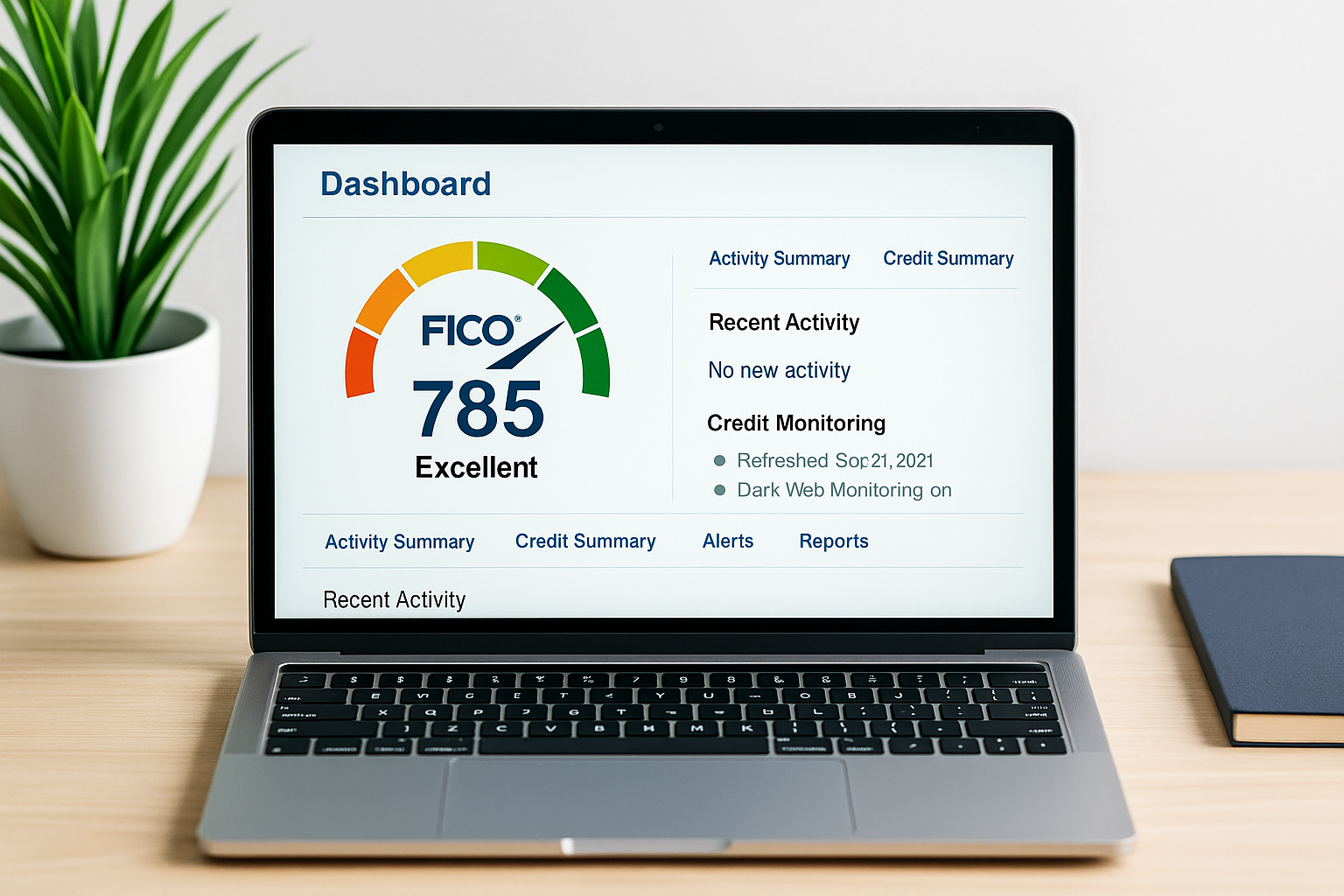
MyScoreIQ gives you real FICO® Score 8 from Experian, Equifax, and TransUnion — updated monthly — along with a score simulator, daily monitoring alerts, dark web scanning, and up to $1 million in identity theft protection. This is the tool we recommend to clients who are actively working to improve their personal credit profile for funding readiness.
- Real FICO® Score 8 — not an estimate
- Daily 3-bureau monitoring with instant alerts
- FICO® Score Simulator — see how changes affect your score before you make them
- $34.99/month after a $1 seven-day trial
Disclosure: This is an affiliate link. MIH Business Academy may earn a commission if you start a membership. We only recommend tools we believe provide real value for credit readiness.
Personal Credit and Business Funding — FAQ
Questions we hear regularly from entrepreneurs working on their credit readiness.
What credit score do I need to qualify for a business loan?
There is no single universal threshold, but most traditional lenders and SBA programs prefer a personal credit score of 680 or higher. Some SBA microloan programs go as low as 620. Alternative lenders may work with scores below 620 but typically charge significantly higher rates. The score is one factor — lenders also review your business revenue, time in business, and documentation.
How long does it take to improve a credit score?
It depends on what is dragging the score down. Reducing high utilization can show results within 30–60 days once the lower balance is reported. Disputing inaccurate accounts and having them removed can also produce relatively fast results. Building length of history and recovering from serious delinquencies takes longer — often 12–24 months of consistent positive behavior. There is no shortcut that works without risk.
Does checking my own credit hurt my score?
No. When you pull your own credit — through a monitoring service or AnnualCreditReport.com — it counts as a soft inquiry, which does not affect your score. Hard inquiries (when a lender pulls your credit in response to an application) are what can lower your score.
Can I get business funding with bad personal credit?
Some funding options exist with lower scores — primarily merchant cash advances and revenue-based advances that weight business revenue more heavily than personal credit. However, these come with significantly higher costs and shorter repayment terms. The better long-term strategy is to address the personal credit profile first so you can access more favorable funding options.
Should I separate my personal and business finances before applying for funding?
Yes — and the sooner the better. Having a separate business bank account, business EIN, and business credit profile shows lenders that your business is a real, organized entity. It also protects your personal finances and keeps your personal credit utilization from being inflated by business expenses charged to personal cards.
What is a Credit Report Analysis and how can MIH Business Academy help?
MIH Business Academy offers a Credit Report Analysis service starting at $150. We review your 3-bureau credit report and provide a written action plan that identifies what is helping your score, what is hurting it, and what practical steps you can take to strengthen your profile for business funding readiness. We do not provide credit repair services or guarantee score increases — we provide education, review, and guidance.
Ready to See Exactly Where Your Credit Profile Stands?
MIH Business Academy offers a professional 3-bureau Credit Report Analysis starting at $150. You will receive a clear written review and practical action plan — so you know what to fix, what to build, and what to protect before you pursue funding.